There’s a specific kind of baking project that looks like it requires serious skill but is actually just about patience – and semla are exactly that. Soft cardamom-spiced buns, hollowed out slightly, filled with almond paste that’s been loosened with a little milk, then topped with a generous cloud of whipped cream and the bun lid placed back on top. Dusted with powdered sugar. That’s it.
Semla (singular: semla, plural: semlor) are a Swedish institution. They’re traditionally eaten on Shrove Tuesday – the day before Lent begins – and the Swedes take this seriously. There are semlor in every bakery from January onward, semlor debates about whether the cream should be piped or spooned, semlor consumed in quantities that would alarm a cardiologist. I first made them after a friend brought a box back from Stockholm and I ate three in one sitting and immediately needed to know how to make them myself.

The thing that makes a good semla is the cardamom dough – it needs to be soft enough to be pillowy but structured enough to hold the filling without collapsing. The almond paste filling should be generous and slightly soft, not dry or crumbly. And the cream should be whipped to firm peaks so it holds its shape when you put the lid back on. Get those three things right and the rest takes care of itself.
These take about 2.5 hours start to finish because of the two rises, but the active work is maybe 30 minutes. Make them on a weekend morning and they’ll be ready for an afternoon treat. They don’t keep particularly well – the cream softens the bun after a few hours – so plan to eat them the day they’re made, ideally within an hour or two of assembling.
If you’re in a Scandinavian baking mood, the hot cross buns use a similar enriched dough and are worth making back to back if you’re already in yeasted-bun mode.
Why This Works
Cardamom is non-negotiable. It’s what makes a semla taste like a semla rather than just a cream bun. Half a teaspoon sounds modest but in an enriched dough it perfumes every bite. Don’t substitute mixed spice or cinnamon – the flavor is completely different and very specifically Swedish. Buy fresh ground cardamom if yours has been in the cupboard for a while; old cardamom loses its punch.
The enriched dough is forgiving. Butter, egg, and milk make this a soft, slightly sticky dough that’s more tolerant of minor over or under-kneading than a lean bread dough. You’re aiming for smooth and elastic but it doesn’t need to be perfect. If it springs back slowly when you poke it, it’s ready. The two rises give the dough time to develop flavor as well as structure – don’t rush either one.
The almond paste filling needs to be soft. This is where home bakers most often go wrong. Almond paste straight from the pack is too firm and dry – it needs to be loosened with milk until it’s spreadable and slightly sticky. You want it to yield when you bite into it, not sit there like a dense plug. About 2-3 tablespoons of milk per half cup of paste is the right direction, but go by texture rather than measurement.
Whip the cream to firm peaks, not stiff. Stiff whipped cream is chalky and holds its shape too rigidly – it won’t meld with the almond paste when you eat it. Firm peaks mean the cream holds its shape but still has a slight softness when you press it. Stop whipping just before you think you need to.
Hollow the buns just enough. You only need to remove a small amount of the crumb from the center – a teaspoon or so – to create a pocket for the filling. Some recipes suggest hollowing aggressively but this weakens the bun structure and makes the lid sit badly. A shallow hollow is all you need.
Delicious and Iconic Swedish Semla Buns
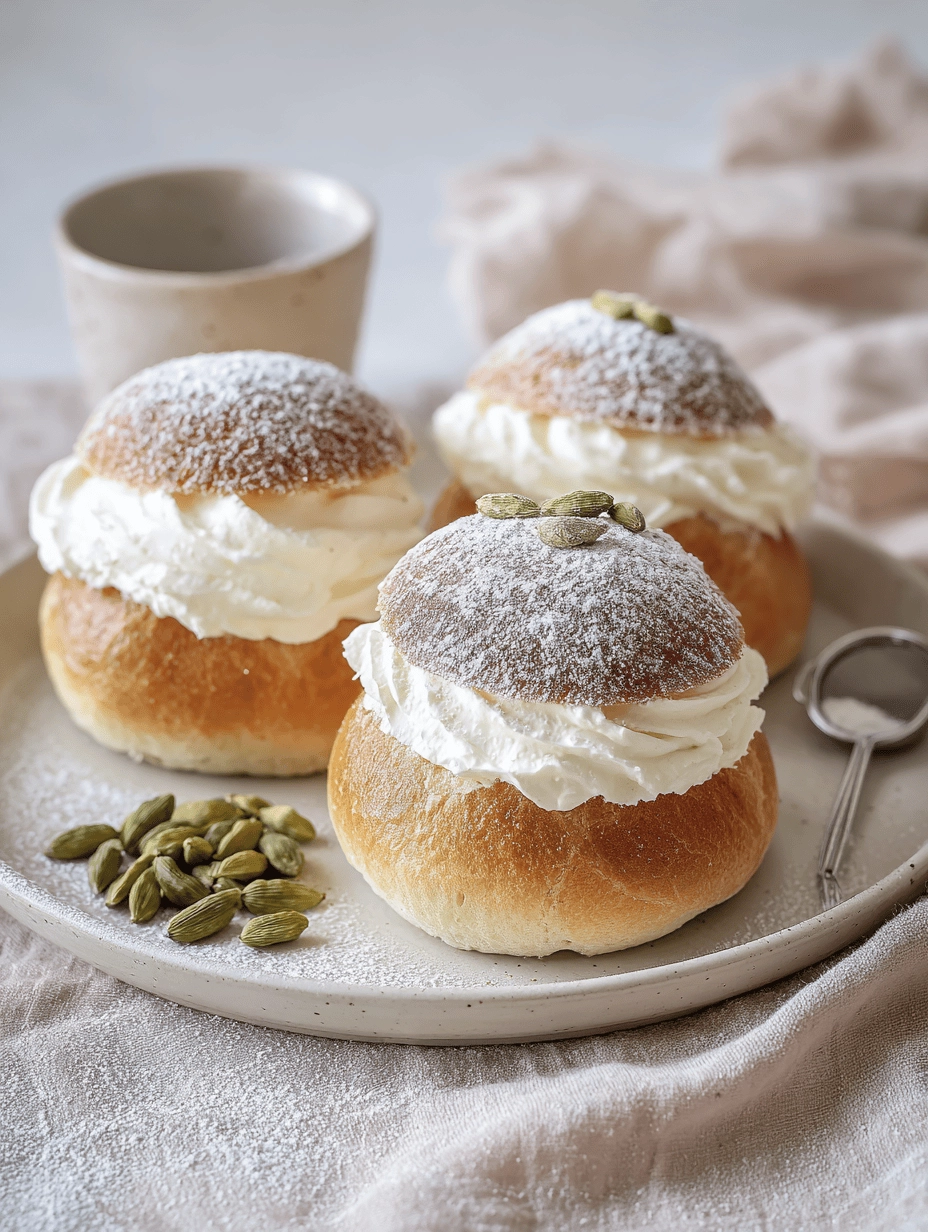
Traditional Semla are soft, fluffy, and mildly spiced with cardamom. The sweet almond filling paired with rich whipped cream creates a luxurious dessert experience. They’re often dusted with powdered sugar, adding a touch of elegance to their appearance.
Ingredients
- 4 cups all-purpose flour
- 1 cup milk
- 1/2 cup sugar
- 1/4 cup unsalted butter, softened
- 1 large egg
- 1 packet active dry yeast (2 1/4 teaspoons)
- 1/2 teaspoon ground cardamom
- 1/2 teaspoon salt
- 1/2 cup almond paste
- 1 cup heavy cream
- Powdered sugar for dusting
Instructions
- Prepare the Dough: In a saucepan, warm the milk until it’s lukewarm. Sprinkle the yeast over the milk and let it sit for about 5 minutes until frothy.
- Mix Ingredients: In a large bowl, combine flour, sugar, egg, cardamom, and salt. Add the yeast mixture and softened butter. Mix until a dough forms.
- Knead: Knead the dough on a floured surface for about 10 minutes until smooth and elastic. Place in a greased bowl, cover, and let rise for 1 hour or until doubled in size.
- Shape the Buns: Once risen, punch down the dough and divide it into 12 equal pieces. Shape each piece into a ball and place on a baking sheet lined with parchment paper. Cover and let rise for another 30 minutes.
- Bake: Preheat the oven to 375°F (190°C). Bake the buns for 15-20 minutes until golden brown. Allow to cool on a wire rack.
- Prepare the Filling: Once the buns are cool, cut off the tops and hollow out a small portion of the center. Mix the almond paste with a splash of milk to create a smooth filling.
- Assemble: Fill each bun with the almond paste mixture, then top with whipped cream. Replace the tops and dust with powdered sugar before serving.
Cook and Prep Times
- Prep Time: 40 minutes
- Cook Time: 20 minutes
- Rising Time: 1 hour 30 minutes
- Total Time: 2 hours 30 minutes
Nutrition Information
- Servings: 12 buns
- Calories: 250kcal (per bun)
- Fat: 12g
- Protein: 5g
- Carbohydrates: 30g
Tips for Getting These Right
Don’t skip the second rise. After shaping the buns, the 30-minute second prove is what gives them the soft, pillowy interior. Buns baked straight after shaping will be denser and tighter. Cover loosely with a clean tea towel in a warm spot – near a preheating oven works well.
Check the buns early. Every oven is different. At 15 minutes start checking – you want a pale golden color, not deep brown. Semla are meant to be soft and light; overbaked buns will be too dry to absorb the filling properly and the texture suffers. A slightly underdone bun is better than an overbaked one here.
Cool completely before filling. Any warmth in the bun will melt the whipped cream on contact. 45 minutes minimum on a rack. If you’re in a hurry, 20 minutes in the fridge once they’re at room temperature will speed things up without affecting the texture.
Cut the lid at an angle. Rather than cutting straight across, angle your knife slightly so the lid is wider on top. This helps it sit more stably on top of the cream and looks more elegant. Cut about a third of the way down from the top.
Serve within 2 hours of assembling. The cream softens the bun lid quickly and the whole thing starts to collapse after a few hours. Make the dough and buns ahead if needed, but assemble just before serving. Unassembled baked buns keep well at room temperature for a day wrapped in a clean cloth.
Make the almond filling the day before. It tastes noticeably better after resting overnight in the fridge – the flavors meld and the texture becomes more cohesive. Take it out 20 minutes before using so it softens slightly.
These work beautifully as part of a Scandinavian-inspired afternoon spread alongside the Bridgerton party food post if you’re hosting something elegant and want a mix of baked treats on the table.
Variations Worth Trying
Add marzipan to the filling. Mix equal parts almond paste and marzipan, loosened with milk. The marzipan adds sweetness and a smoother texture – closer to what you’d get in a Stockholm bakery.
Flavor the cream. A teaspoon of vanilla extract in the whipped cream is a natural addition. Some Swedish bakers add a small amount of cardamom to the cream as well, which ties everything together beautifully.
Hetvägg style. The traditional way to eat semla in Sweden is “hetvägg” – dropped whole into a bowl of warm milk, lid and all, and eaten with a spoon. It sounds strange and is genuinely excellent. The bun soaks up the milk slowly and the cream dissolves into it. Worth trying at least once.
Make them smaller. Divide the dough into 16 pieces instead of 12 for smaller, two-bite semla – good for parties or afternoon tea where you want people to be able to try everything. Reduce the baking time to 12-14 minutes.

Make-Ahead and Storage
The baked, unfilled buns keep at room temperature for up to 24 hours wrapped in a clean cloth or in an airtight container. After that they start to dry out. The almond paste filling keeps in the fridge for up to 3 days and genuinely improves overnight. Whip the cream fresh just before assembling – pre-whipped cream weeps and loses texture.
Assembled semla don’t store well – the cream softens the bun lid within 2-3 hours and the whole thing becomes soggy by the next day. If you have leftover assembled semla, eat them within a few hours or accept that tomorrow’s breakfast will be a slightly deflated but still delicious bun.
The dough can be made the night before and left to do its first rise overnight in the fridge instead of at room temperature. This slow cold rise actually improves the flavor. Take it out in the morning, let it come to room temperature for 30 minutes, then shape, prove, and bake as normal.
FAQs
Q1: Can I use instant yeast instead of active dry?
Yes – use the same amount (one packet, 2¼ teaspoons) and skip the initial activation step. Add instant yeast directly to the dry ingredients rather than the warm milk. The rise times will be very similar. Both work well here.
Q2: I can’t find almond paste – can I substitute marzipan?
Marzipan works but it’s sweeter and softer than almond paste, so use slightly less milk when loosening it and taste as you go. Alternatively, make a quick almond filling by blending 100g ground almonds with 50g powdered sugar, a few drops of almond extract, and enough milk to bring it together. It’s not identical to traditional almond paste but it works well and most people can’t tell the difference.
Q3: My dough isn’t rising – what went wrong?
Almost always the milk was too hot and killed the yeast. The milk should feel comfortably warm on your wrist, not hot – around 100-110°F (38-43°C). If you’re not sure, err on the side of too cool rather than too warm. Yeast that doesn’t foam after 5 minutes in warm milk is dead and the dough won’t rise – start again with fresh yeast rather than wasting time waiting.
Q4: Can I make these dairy-free?
The dough works well with oat milk or almond milk in place of regular milk. Use dairy-free butter (a solid block variety rather than spread) for the dough. For the filling, a dairy-free cream cheese loosened with plant milk makes a reasonable substitute for the almond paste mixture. For the topping, full-fat coconut cream whipped cold works well – chill the can overnight and whip just the solid part.
Q5: How do I know when the buns are properly baked?
They should be pale golden – not deep brown – and sound hollow when you tap the bottom. The internal temperature should be around 190°F (88°C) if you want to be precise. They’ll feel slightly firm on the outside but give softly when pressed. Remember they continue to firm up as they cool, so pulling them slightly early is better than leaving them in too long.
Q6: Can I freeze semla?
The baked, unfilled buns freeze well for up to a month – wrap individually and thaw at room temperature for about an hour. Don’t freeze assembled semla as the cream and almond filling don’t survive freezing well. The almond paste filling also freezes fine on its own. Whip fresh cream for assembly after thawing.
Q7: My cream is sliding off – what’s happening?
Either the buns weren’t fully cool when you assembled them, or the cream was slightly under-whipped. Make sure buns are completely cold, whip the cream to firm peaks (it should hold its shape clearly when you lift the whisk), and be generous with the almond paste layer – it acts as a base that anchors the cream. A piping bag gives you more control than a spoon for placing the cream neatly.
Q8: What’s the difference between semla and a cream bun?
The cardamom in the dough is the main distinguishing feature – it gives semla a very specific warm, floral flavor that a standard cream bun doesn’t have. The almond paste filling is also unusual – most cream buns use just jam or plain cream. Traditionally semla are also eaten with the lid placed back on top rather than left open, which keeps the cream more contained and makes them easier to eat. The combination of cardamom dough, almond paste, and cream is uniquely Swedish and genuinely unlike anything else.

Traditional Swedish Semla Buns Recipe
Love it? Click to rate
Ingredients
Method
- Prepare the Dough: In a saucepan, warm the milk until it’s lukewarm. Sprinkle the yeast over the milk and let it sit for about 5 minutes until frothy.
- Mix Ingredients: In a large bowl, combine flour, sugar, egg, cardamom, and salt. Add the yeast mixture and softened butter. Mix until a dough forms.
- Knead: Knead the dough on a floured surface for about 10 minutes until smooth and elastic. Place in a greased bowl, cover, and let rise for 1 hour or until doubled in size.
- Shape the Buns: Once risen, punch down the dough and divide it into 12 equal pieces. Shape each piece into a ball and place on a baking sheet lined with parchment paper. Cover and let rise for another 30 minutes.
- Bake: Preheat the oven to 375°F (190°C). Bake the buns for 15-20 minutes until golden brown. Allow to cool on a wire rack.
- Prepare the Filling: Once the buns are cool, cut off the tops and hollow out a small portion of the center. Mix the almond paste with a splash of milk to create a smooth filling.
- Assemble: Fill each bun with the almond paste mixture, then top with whipped cream. Replace the tops and dust with powdered sugar before serving.
Nutrition
Notes
- Almond paste filling: loosen with 2-3 tablespoons of milk until spreadable and slightly sticky – it should yield when you bite it, not sit dry and firm.
- Milk temperature for activating yeast: warm on your wrist, not hot. Too hot kills the yeast.
- Cool buns completely before assembling – at least 45 minutes. Warm buns melt the cream immediately.
- Best eaten within 2 hours of assembling.
Tried this recipe?
Let us know how it was!Want this recipe emailed to you?