This post contains affiliate links. If you purchase through them I may earn a small commission at no extra cost to you.
The first time I set up a slider bar for a party I spent the whole evening in the kitchen reheating individual batches and bringing them out in small waves while everyone else was having a good time. Never again.
A properly set up slider bar means you do all the work before anyone arrives and then join the party. The sliders stay warm, the toppings are laid out, and people help themselves. It’s genuinely one of the easiest ways to feed a crowd and it always looks like you’ve put in more effort than you actually have.
Here’s exactly how to set one up – quantities, equipment, which sliders work best, and how to keep everything warm without standing over it all evening.
Why a Slider Bar Works So Well for Parties
There are a few things that make sliders genuinely perfect party food. They’re the right size – small enough that guests can try more than one variety without committing to a full portion of anything, big enough to be satisfying. They’re casual and interactive in a way that a plated dish isn’t. And because most slider components can be made ahead, you’re not stuck in the kitchen while everyone else is having fun.
The bar format specifically works because it removes the bottleneck of serving. Instead of plating food and bringing it out in batches, everything is on the table and guests serve themselves. You set it up once, keep an eye on the warmers, and that’s it.
How Many Sliders Per Person
This is the question I get asked most often and the honest answer is it depends on the context, but here’s a simple guide:
For a party where sliders are the main food and people are genuinely hungry, allow 4-5 sliders per person. For a party where sliders are part of a wider spread alongside other food, 2-3 per person is enough. For a grazing situation where people are eating over several hours rather than sitting down to a meal, 2 is usually plenty.
If you’re offering two or three different slider varieties at the bar, the total number per person stays the same but people will naturally split their choices across the varieties. So for 10 guests at a party where sliders are the main food with two varieties, make 25 of each.
Always make a few extra. Sliders disappear and running out is worse than having leftovers.
Which Sliders Work Best for a Bar
Not all sliders are equally suited to the bar format. The key question is whether they hold up to being made ahead, kept warm for an hour, and self-served.
Best for a slider bar:
The ham and cheese sliders on Hawaiian rolls are the ultimate slider bar recipe. You assemble the whole tray, cover it, refrigerate it, and bake it when you need it. They hold their heat well in the baking dish and guests can break them apart themselves. These are my first recommendation for anyone setting up a bar for the first time.
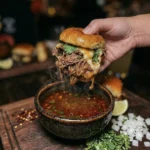
The birria sliders with consomme dipping sauce are slightly more involved but spectacular at a party – the dipping element becomes interactive and the consomme can be kept warm in a small pot or slow cooker on the table. People love the experience of dipping.
The white pizza sliders bake beautifully in a connected sheet and hold well under foil. They don’t need any assembly from guests – just pull apart and eat.
The marry me chicken sliders work well if you keep the sauce warm separately and let guests spoon it over themselves – it’s a nice interactive element and means the buns don’t go soggy from sitting in the sauce.
Sliders that need last-minute assembly:
Anything with crispy chicken – the hot honey chicken waffle sliders, the spicy miso glazed chicken, and the Nashville hot honey sliders – are best assembled fresh since the crispy coating softens quickly once it’s in a bun. For a bar, either fry the chicken in batches throughout the evening or accept that the coating will be less crispy. Both are still delicious.
Setting Up the Topping Station
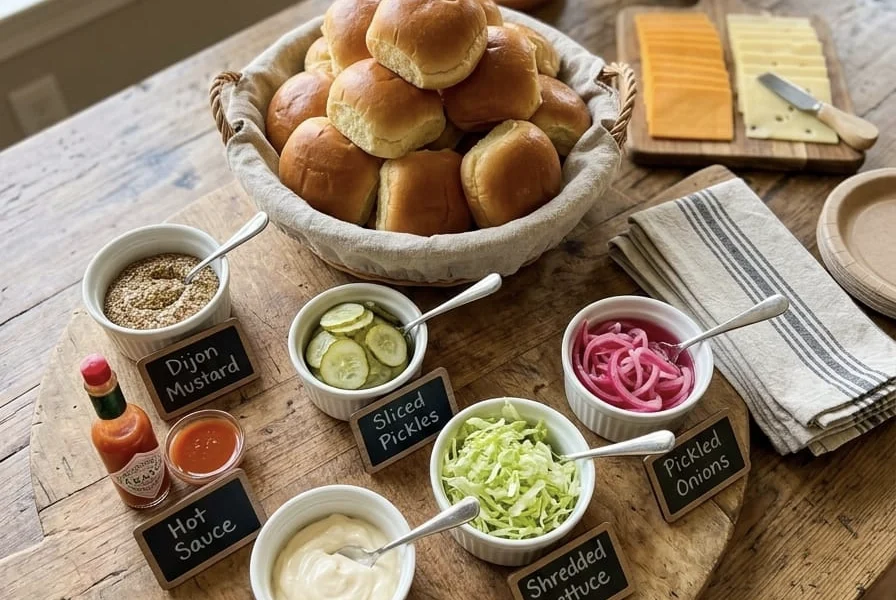
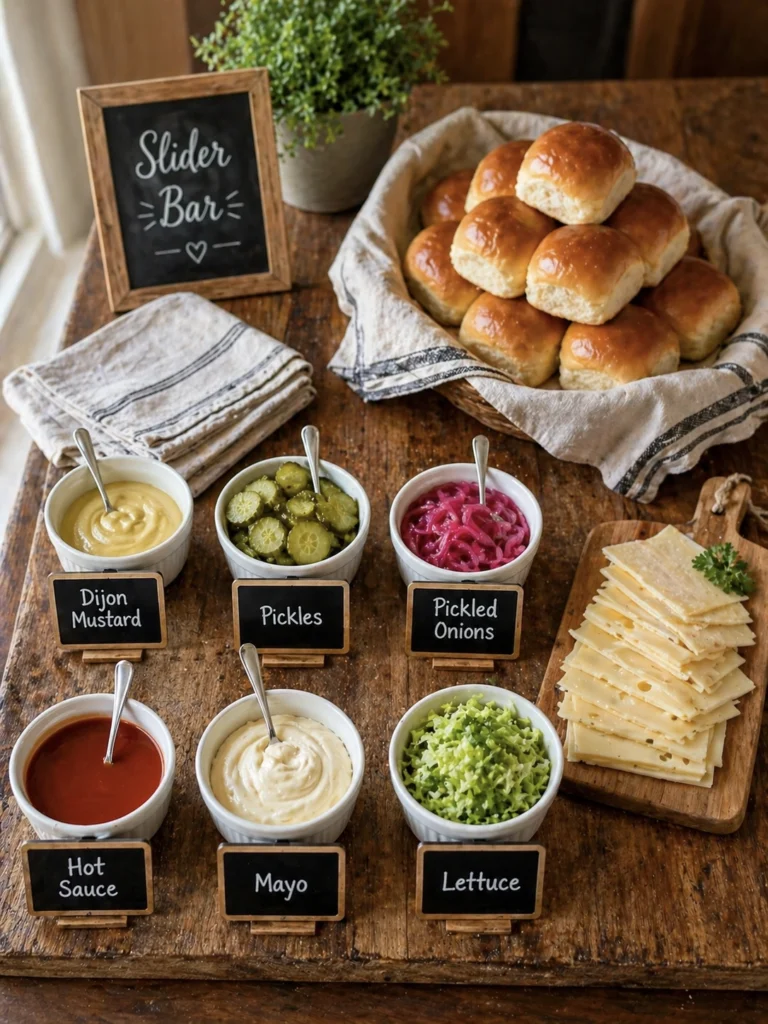
The topping station is what makes a slider bar feel like a proper spread rather than just a plate of food. The idea is to lay out small bowls of condiments and extras so guests can customise their own.
For a general slider bar covering multiple varieties, the toppings that work across almost everything are:
- Dijon mustard
- Mayonnaise or aioli
- Hot sauce
- Quick pickled red onions
- Sliced dill pickles
- A simple slaw
- Fresh lettuce leaves
- Sliced tomatoes
For themed bars – all Asian-inspired sliders, all beef sliders, all chicken – narrow the toppings to match the flavors. A miso chicken slider bar wants sesame mayo, cucumber pickles, and scallions rather than Dijon and dill pickles.
Small individual bowls for each topping look much better than everything in one large dish and make it easier for guests to serve themselves without things getting mixed together. I use a set of small ceramic prep bowls which work perfectly for condiments and look great on a board or table.
Label each topping clearly, especially if any contain allergens. Small chalkboard label cards propped in front of each bowl look beautiful and take about 30 seconds to write. Guests with dietary requirements will thank you.
How to Keep Sliders Warm
This is the part that trips people up most. Sliders served cold or lukewarm are a disappointment. Here are the options:
The baking dish method (easiest). For baked sliders like the ham and cheese or white pizza, keep them in the baking dish covered with foil in a low oven at 170°F (75°C). They’ll hold their heat for up to an hour without drying out. Bring the whole dish to the table and let guests pull them apart themselves.
The slow cooker method (best for braised meats). For the birria beef or any other braised meat, a slow cooker on the warm setting keeps the meat perfectly moist for hours. Set it on the table with the buns alongside and let guests build their own. This is my favourite setup for a hands-off bar.
A chafing dish (best for large parties). If you’re feeding 20 or more people, a chafing dish with a fuel burner keeps food at serving temperature for several hours without any electricity needed. They look professional, they’re inexpensive, and they solve the keeping-warm problem completely for big gatherings.
The warming tray method. An electric warming tray on the table keeps food at a consistent temperature and takes up less space than a chafing dish. Good for medium-sized gatherings.
The Equipment That Makes It Easy
You don’t need much but a few specific pieces make the whole setup look intentional rather than improvised.
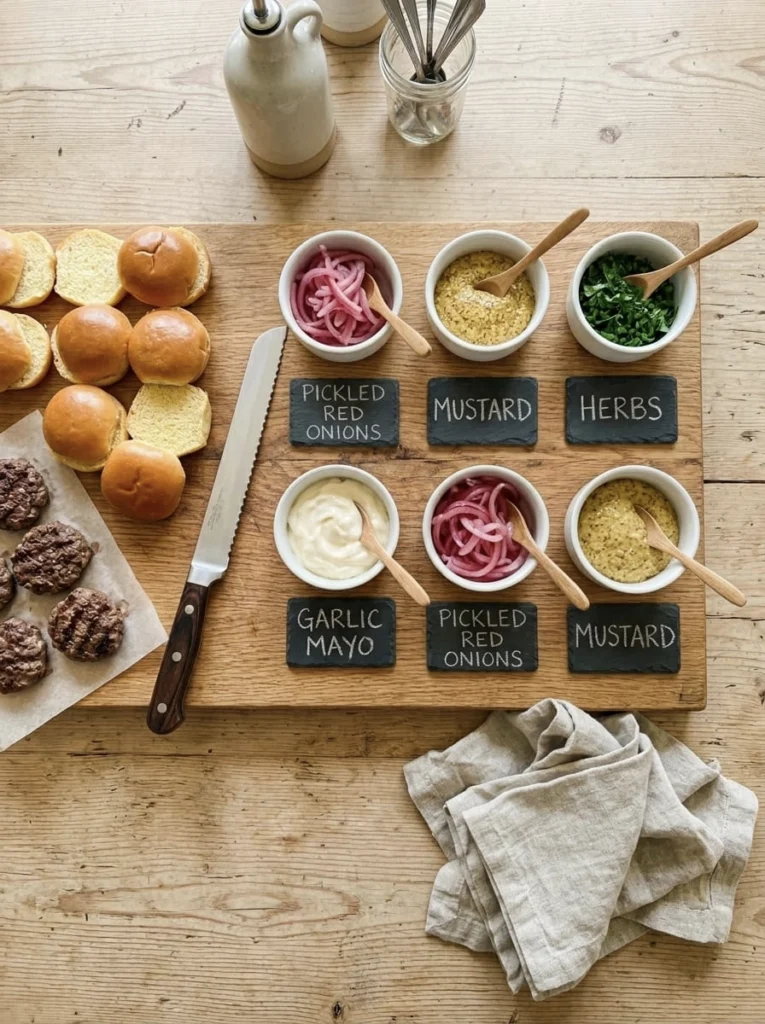
A large wooden serving board as the base of the display ties everything together visually. Arrange the slider dish, the topping bowls, and the napkins all on one board and it looks like a considered spread rather than random dishes on a table.
A set of small ceramic condiment bowls – I’d suggest at least 6 – for the toppings. Mismatched is fine and actually looks more relaxed and inviting than a perfectly matched set.
Chalkboard label cards for identifying each slider variety and each topping. Guests shouldn’t have to guess what they’re picking up.
A serrated knife on the board for cutting sliders if they’re in a connected sheet. A bread knife with a long blade cuts through an entire tray of Hawaiian rolls in one motion.
Small cocktail napkins or paper napkins in a holder alongside the board. Sliders are finger food and people need somewhere to wipe their hands.
Make-Ahead Timeline
The thing that makes a slider bar genuinely stress-free is doing as much as possible before anyone arrives. Here’s how I approach it:
Up to 3 days ahead: Make caramelized onions. Make quick pickled red onions and cucumber pickles. Make any braised meat (birria beef, pulled pork). Make sauces and dressings. All of these improve with time in the fridge.
The day before: Assemble any baked sliders (ham and cheese, white pizza) and refrigerate unbaked. Shred cheese. Prepare the slaw. Chop herbs and toppings that keep well overnight.
The morning of: Set out all serving equipment. Fill condiment bowls. Write the labels. Prep anything that needs to be done fresh.
1 hour before guests arrive: Start the oven for baked sliders. Set the slow cooker on warm if using braised meat. Arrange the board.
As guests arrive: Bring the baked sliders out of the oven, set on the board, and you’re done. Everything else is already on the table.
Suggested Slider Bar Menus
The Classic Bar (easiest, most crowd-pleasing):
Ham and Cheese Sliders on Hawaiian Rolls plus Nashville Hot Honey Chicken Sliders. One for everyone, one with a kick. Toppings: mustard, mayo, pickles, hot sauce, lettuce.
The Showstopper Bar (a bit more effort, unforgettable):
Birria Sliders with Consomme Dipping plus White Pizza Sliders plus Hot Honey Halloumi Sliders. Something for beef lovers, something for vegetarians, and the interactive dipping element that becomes the talking point of the evening.
The Easy Weeknight Bar (quick setup, midweek gathering):
Ham and Cheese Sliders plus White Pizza Sliders. Both bake in the same oven at the same temperature. Assemble both trays, bake together, bring to the table. Done in under an hour from start to finish.
The Asian-Inspired Bar:
Spicy Miso Glazed Chicken Sliders plus Smash Burger Sliders with Brie and Caramelized Onions. Toppings: sesame mayo, cucumber pickles, sriracha, scallions, cilantro.
FAQ Section
For the full collection of slider recipes to build your bar around, the slider recipes roundup has all 10 with full recipes for everything including the birria, the marry me chicken, and the spicy miso glazed chicken.